
Some mornings feel heavy before they even begin.
You wake up, reach for your phone, stumble toward coffee, and hope your energy catches up later. For many people, the first hour of the day becomes a reaction: to alarms, messages, caffeine, stress, or a schedule that already feels full.
A morning light and hydration routine is not a miracle fix. It will not guarantee perfect energy, replace sleep, or solve persistent fatigue. But it can give your body two simple signals early in the day: it is time to be awake, and basic needs are being met.
That is why so many people say morning light and water “change their day.” Often, what changes is not dramatic. It is the feeling of starting with less fog, less rush, and more rhythm.
Why do morning light exposure and hydration help people feel like their day starts better?
Morning light exposure and hydration may help people feel like their day starts better because they support two basic body signals: wakefulness and fluid balance. Morning light helps cue the body’s circadian rhythm, while water helps replace fluids after several hours without drinking.
Together, they create a simple transition from sleep into the day. This can feel grounding, especially when it happens before caffeine, screens, and stress.
This routine is best understood as daily support, not a medical intervention. It may help some people feel more alert and steady, but it does not replace sleep, nutrition, movement, or professional care when fatigue is persistent or unexplained.
A morning light and hydration routine works because it gives the body two practical early-day signals: natural light helps support circadian timing and alertness, while water helps address fluid needs after the overnight fast. The routine is simple, low-cost, and habits-first, but it should not be presented as a cure for fatigue or a replacement for sleep, nutrition, or medical evaluation when symptoms are ongoing.
The real concern behind this habit
Most people are not asking about morning light and hydration because they want another wellness rule.
They are usually asking because mornings feel harder than they should.
Maybe they wake up tired even after sleeping. Maybe they need coffee before they can think clearly. Maybe their energy starts low and then crashes later. Maybe they are trying to build a better morning routine, but everything online feels too complicated.
A simple light-and-water habit is appealing because it does not require equipment, supplements, a long workout, or a perfect schedule. It is a small starting point.
And small matters. A routine that takes five minutes and actually happens is often more useful than a beautiful morning plan that only works on vacation.
What morning light exposure does for daily energy and alertness

Morning light is one of the strongest environmental cues for the body’s internal clock, often called the circadian rhythm. Research on light and circadian biology shows that morning light generally tends to shift the internal clock earlier, while evening or nighttime light can shift it later. (PMC)
In everyday language, this means morning light helps tell your body, “The day has started.”
That signal may support:
- Feeling more awake in the morning
- A clearer day-night rhythm
- Better timing between sleepiness and alertness
- A more consistent morning routine
- A stronger contrast between daytime and evening
This does not mean sunlight is an instant energy button. If you slept poorly, are under heavy stress, or have an underlying health issue, morning light may not be enough to make you feel restored.
But as a daily cue, it can be powerful because the body is responsive to light. Light exposure plays a central role in circadian regulation, sleep timing, and alertness patterns. (PMC)
Why outdoor light often feels different
Outdoor light is usually much brighter than indoor light, even when the sky is cloudy. That is one reason a few minutes outside may feel different from sitting near a lamp indoors.
You do not need to stare at the sun. In fact, you should not. The goal is simply to be in natural daylight safely: on a porch, near a window that opens to daylight, during a short walk, or while standing outside with water before coffee.
If outdoor time is not possible, bright indoor light may still help create a better wake-up environment than staying in a dark room.
Why hydration is important in the morning
Hydration is one of those habits that sounds too basic to matter. But basic needs are still needs.
After a night of sleep, most people have gone several hours without fluids. You may not be severely dehydrated, but starting the day with water can be a simple way to support normal hydration before adding caffeine or rushing into activity.
The CDC notes that getting enough water helps prevent dehydration, which may contribute to unclear thinking, mood changes, overheating, constipation, and kidney stones. (CDC)
Mild dehydration may also affect how energy and focus feel. A scientific review notes that even mild dehydration, around 1–2% body water loss, can impair cognitive performance. (PMC)
That does not mean every tired morning is caused by dehydration. It means water is a sensible first step because it supports a basic function your body already depends on.
Water before coffee is a simple shift
Coffee is not the enemy. For many people, caffeine can be part of a normal morning. The problem is when caffeine becomes the first and only response to low energy.
A gentler sequence is:
Water first.
Light next.
Coffee after, if you want it.
This does not need to be rigid. You do not have to earn your coffee. You are simply giving your body hydration before stimulation.
How to build a simple morning light and hydration routine
A morning light and hydration routine should be easy enough to repeat on normal days, not just ideal days.
Here are three versions.
| Routine length | What to do | Best for | The goal |
| 5 minutes | Open curtains or step outside, drink a glass of water, take a few slow breaths | Busy mornings, parents, early workdays, low motivation | Create a clear “day has started” signal |
| 10 minutes | Drink water outside or near daylight, walk slowly, stretch shoulders or neck | People who wake up foggy or stiff | Combine light, hydration, and gentle movement |
| 15 minutes | Step outside with water, take a short walk, delay phone/email, then have breakfast or coffee | People building a steadier morning routine | Start the day with rhythm before stimulation |
The five-minute version is enough. The 15-minute version is not morally better. A habit works when it fits your real life.
The simplest version
Put a glass of water where you will see it.
Then, within the first part of the morning:
- Open the curtains or turn toward daylight.
- Drink water before or alongside coffee.
- Step outside for a few minutes if possible.
- Avoid starting with your phone when you can.
This is not glamorous. That is the point. It is simple enough to repeat.
How long should someone spend outside in the morning light?
There is no perfect number that fits everyone.
A practical starting point is 5 to 15 minutes of morning daylight, depending on your schedule, weather, season, skin sensitivity, location, and comfort. Some people may prefer a longer walk. Others may only have time to stand outside briefly.
The key is consistency, not perfection.
| Situation | Realistic light option |
| You have 2 minutes | Open the door or stand near a bright window |
| You have 5 minutes | Step outside with water before coffee |
| You have 10 minutes | Take a short walk around the block |
| You commute | Get daylight on the way to work or school |
| It is cloudy | Go outside anyway if safe; outdoor light can still be useful |
| It is dark when you wake | Use indoor light first, then get daylight later when available |
Avoid looking directly at the sun. If you have eye conditions, take medications that increase light sensitivity, or have specific medical concerns, ask a qualified healthcare professional what is appropriate for you.
What this routine can and cannot do
A morning light and hydration routine may help your day feel more grounded. It may support alertness, routine consistency, and better hydration. It may also make caffeine feel less like an emergency tool.
But it cannot do everything.
It cannot replace enough sleep.
It cannot make up for chronic stress by itself.
It cannot correct an unbalanced diet.
It cannot treat medical causes of fatigue.
It cannot guarantee steady energy all day.
That honesty matters. The value of this habit is not that it solves everything. The value is that it gives you a better starting point.
When supplements should be considered
Supplements should come later, not first.
Before adding anything for morning energy, it makes sense to look at the basics:
- Are you getting enough sleep?
- Are you waking at a reasonably consistent time?
- Are you getting morning light?
- Are you drinking enough fluids?
- Are you eating in a way that supports your morning?
- Are you relying on caffeine to compensate for poor recovery?
- Is fatigue persistent, extreme, or unexplained?
Some people eventually explore options like electrolytes, magnesium, creatine, vitamin D, B12, or iron. But those choices should be made carefully. For example, iron or B12 questions are best guided by labs and a healthcare provider, not guesswork.
A softer, safer approach is to build the routine first. Then, if you still feel something is missing, consider one change at a time.
Supplements may support a broader routine for some people. They should not become the foundation of morning energy.
A gentle one-week experiment
Try this for one week:
| Morning habit | What to track |
| Drink water before or with coffee | Do you feel less sluggish or headachy? |
| Get daylight early | Do you feel more awake by mid-morning? |
| Delay phone for a few minutes | Does the morning feel less reactive? |
| Take a short walk if possible | Does your body feel less stiff? |
| Keep the routine small | Is it easier to repeat? |
You do not need to track perfectly. Just notice.
If nothing changes, that does not mean you failed. It may mean another factor matters more: sleep, stress, nutrition, workload, caffeine timing, or health concerns.
When fatigue needs more than a morning routine
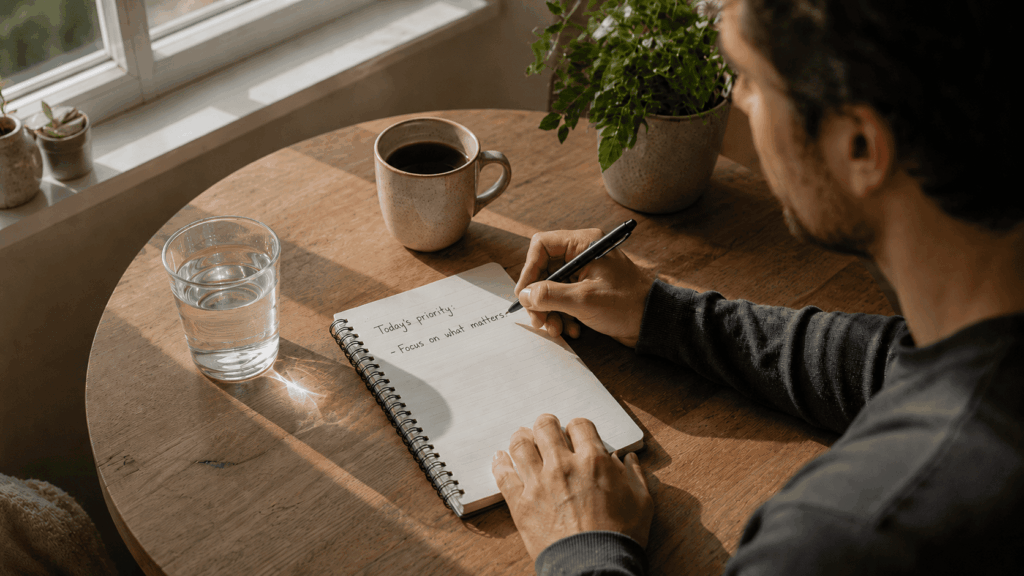
Morning light and hydration are supportive habits. They are not medical care.
If fatigue is persistent, extreme, unexplained, worsening, or interfering with daily life, it is worth discussing with a healthcare provider. This is especially important if fatigue comes with symptoms such as shortness of breath, chest pain, fainting, irregular heartbeat, severe headaches, unexplained weight changes, heavy bleeding, or mood changes.
Mayo Clinic notes that fatigue can be linked with many causes and may require medical evaluation when it is ongoing or severe. (Mayo Clinic)
This article is educational and is not medical advice.
A better day can start with a smaller routine
A morning light and hydration routine is not about becoming a new person before breakfast. It is about giving your body a calmer start.
Light helps signal daytime.
Water helps meet a basic need.
A few minutes outside can create a pause before the day speeds up.
A small routine can make the morning feel less random.
Start with the version you can actually repeat:
- Open the curtains.
- Drink water.
- Step into daylight.
- Take one slow breath before caffeine, screens, and demands.
That may not transform every morning. But for many people, it is enough to make the day feel like it begins with support instead of pressure.

Mary writes about energy, longevity and everyday wellness habits — with an honest eye on what the evidence actually says. Her approach is simple: habits first, supplements second, and no promises she can't back up.